Markovian and Barberpole
Markovian and Barberpole
I'm learning about POMDP. I had a sudden realisation / recollection of the barberpole illusion / aperture problem.
- the Markov Property:
- “the memoryless property of a stochastic process, which means that its future evolution is independent of its history.”
- it assumes perfect, complete, and sufficient state information
Barberpole Illusion: a visual illusion where stripes on a rotating pole appear to move vertically, even though they are rotating around the pole. our brain interprets motion based on partial information (the 2D projection), missing the full 3D context
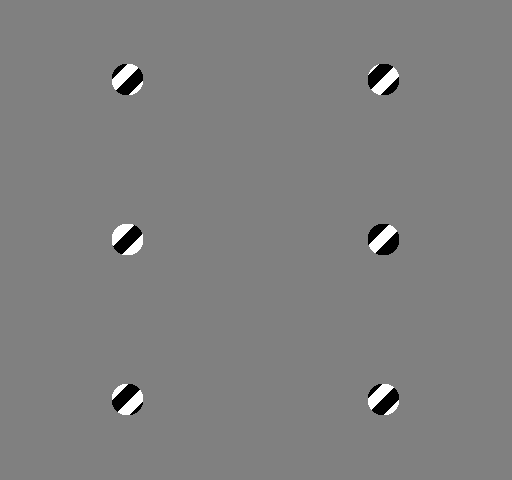
Figure 1: Partially Observed
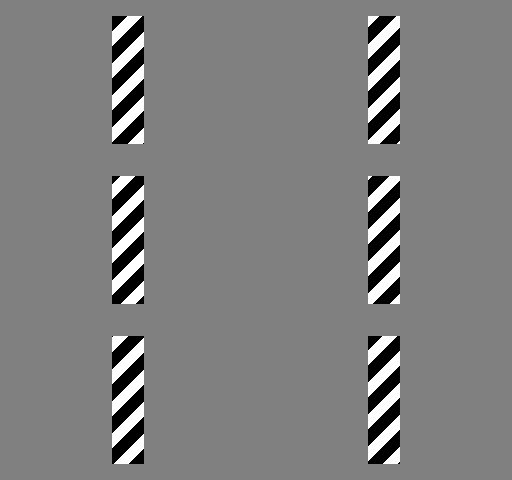
Barberpole illusion just showed that, a (narrowed) perception (and state) could be deceptive;
- the real state (3D motion) can't be determined from the current view alone
- observers may question the fact that the strips are not moving sideways only if they have learned about a phenomenon called the “barberpole illusion”
- and that is non-markovian
POMDP seems to double down on this: first the Markov property (on state transition), then partial/noisy observation.
I think in many real world systems, the current state might not be able to capture all relevant info (like hidden variables, past events, un-observable dynamics), just like in the Barberpole illusion.